
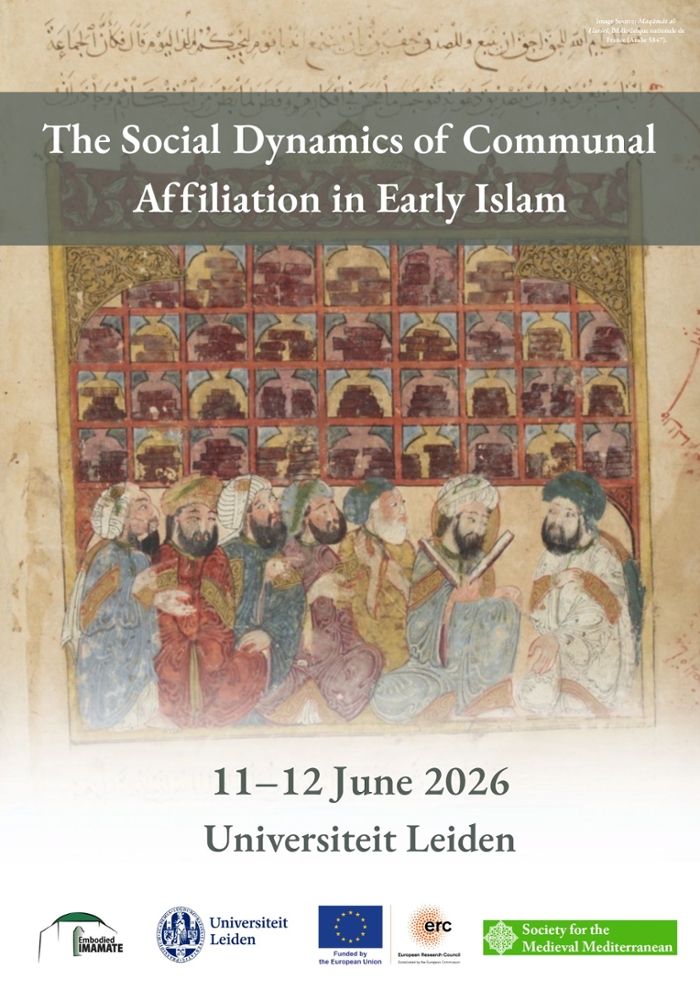
SRI will be participating in “The Social Dynamics of Communal Affiliation in Early Islam” — a two-day international workshop hosted by Leiden University.
Please see the schedule here
In much existing scholarship, our understanding of Muslim groups in early Islam has been gauged through a reliance on later works of heresiography and doxography. These fourth/tenth century works portray a diverse range of groups (including the Imami, Zaydi, and Ismaili Shiʿa, Kharijis, Muʿtazilis, Murjiʾis, and various others who eventually came under the banner of ‘Sunnism’) emerging in the first three centuries of Islam, often over issues surrounding the rightful political leadership of the Muslim community and later coalescing around other theological beliefs which facilitated more coherent, structured systems for members of these groups to adhere to. Studies engaging with such works have greatly enriched our understanding of the doctrines and beliefs ascribed to these groups, their evolution over time, and what images the sources construct of them.
In studies on the social dynamics of this period, however, more attention has been paid to relations between Muslim and non-Muslim groups through processes such as conversion and cross-communal engagement with alternative legal systems than has been between the various Muslim groups. There is arguably a lacuna in thinking about how individuals belonging to divergent Muslim groups interacted, and how the interactions between them were practically structured. Research on interactions between Muslims belonging to divergent groups has tended to focus on theological polemics or political violence, rather than day-to-day interactions. We therefore lack a deeper understanding of what it meant to belong to a Muslim group during this early period of the first/seventh to third/ninth centuries on a more practical level. This workshop, organised under the auspices of the ERC Horizon Starting Grant project ‘Embodied Imamate: Mapping the Development of the Early Shiʿi Community 700-900 CE’ with the support of the Society for the Medieval Mediterranean, aims to address this these concerns.
It is gatherings like these that remind us why rigorous, grounded scholarship on early Shiʿi history matters — and we are proud to be part of the conversation.